Visual kei is a Japanese subculture most known for its distinct fashion and music style. I chose to do my ethnography on this subject because it is not well-known and it is a very interesting topic, both to those familiar and unfamiliar with it. I was able to learn about the different kinds of literates used within the visual kei subculture and how I have implemented and been affected by them in my own life. Visual kei is an important topic to me because it allows both the fans and the bands to express themselves without limits or fear of judgment. This project was created to expose visual kei to a wider audience, but it also helped me get to know the genre better. I was able to realize my own prejudices when it came to groups I was unfamiliar with, and so I was able to develop a deeper appreciation for the many artists who also identify with visual kei.
Doing this ethnography changed my perspective, even more than I thought it would. I realized that there are many ways people can express themselves and we are not limited to typical, "normal" methods. Visual kei artists have a lot of freedom in what they create, especially compared to other more mainstream artists. Everything from their image, song lyrics, and music compositions are so unique because of this freedom of expression. With each release, bands are able to create a package that relates not only to themselves but to their fans as well. This ethnography exposed me not only to more bands but an entirely new art form.
This research project was completed for English 1302: Written Argument and Research, a course taught by Jennifer Jones at Texas A&M University-Commerce, Spring 2015.
28 April 2015

WA5/Final Ethnography: Visual Kei
I chose my site because I am a big fan of visual kei and wanted to learn more about it. My fixed position on this site is mainly based on my nationality since I am American and visual kei is part of Japanese culture. Because of this, I may not see things in the exact same way as fans either from Japan or fans from other countries. My subjective position is based on the fact that I do have some knowledge about Japanese culture so I can understand why certain things may be seen differently across borders. I am able to get an understanding of visual kei from a Japanese standpoint and an American standpoint.
Before learning more about visual kei, I was not very well-versed in it. I had one particular band that I was a fan of, but I did not know much about other bands and the diversity of visual kei when it comes to music and fashion styles. I expected to learn about the different types of visual kei, mainly in association with the music. What I ended up learning about was how visual kei is an entire culture in and of itself and the music is just a small, albeit important, element of that culture.
There a lot of things I wanted to learn through my research. I wanted to learn how people incorporate and are influenced by visual kei in their lives. I wanted to know how visual kei was formed and how it differed from other Japanese subcultures. I also wanted to know the biggest differences between the older and more modern styles of visual kei.
Visual kei is part of a culture that interests many different people from many different backgrounds. It is also something that those who are not familiar with Japanese pop culture may know nothing about. The visual kei community, or fandom as it is often referred to, is made up of a variety of mini-fandoms, all of which are connected through a common interest, visual kei. To those unfamiliar with the community, visual kei may seem like an entirely foreign concept. I think visual kei is an interesting topic because it is an obscure subculture, even in its native land of Japan and is even more obscure in other countries. Despite this obscurity, people from all over the world have been able to come together, talk, discuss, and voice their opinions on the visual kei subculture.
The arena is completely dark with the exception of a few carefully selected strobe lights that graze across the scene. The drums maintain a steady beat that grows in intensity the longer it goes on. The audience claps in tune with the drums to create an atmosphere that is slowly building. Everything slows to stop but the drums continue their tempo. As the next member emerges from the left, the audience screams in excitement. The other three members follow, the audience’s cheers growing louder with each entrance. The air swells as everything comes together and for a moment, there is complete silence. This still moment passes quickly and is interrupted by drums, two guitars, and a bass as they start the first song. The audience cheers loudly as a familiar tune starts to play and the vocalist pumps them up further with a loud, “Let’s go!”
This is just one example of how a live visual kei concert can begin. This is a relatively large concert in a large venue, completely sold out and full of fans who have been waiting hours for this moment. On the other hand, visual kei concerts can be performed on a smaller scale with a smaller audience. With the wide variety of bands that identify with visual kei, the ways that bands can make a name for themselves through their music and live performances are infinite.
The main aspect of visual kei, as suggested by its name, is the visuals. The most identifiable traits of visual kei are the makeup, elaborate hairstyles, unique clothing, and sometimes androgynous aesthetics that many bands use. A lot of bands are able to use the style to create their own distinct trademark in the visual kei genre.
The oldest and most established form of visual kei is called kote kei. It is known as the classic style and is often called the vintage form of visual kei. Many older bands had this style when they first started and it was the most popular form during the 1980s and through the 1990s. The style consists of dramatic clothing and hairstyles and most closely resembles the goth look out of all the visual kei styles. Most of the clothing is black with hints of red or sometimes purple. The hair is where most of the brighter colors come from, with members dyeing their hair within a wide spectrum of colors from blonde to red, purple, or blue. The most popular bands associated with the style include Malice Mizer, Dir En Grey, and X Japan.
The most distinctive and well-known style of visual kei, almost stereotypically so, is called oshare kei. Oshare kei stands in almost stark contrast to the other styles of visual kei since it is very bright, colorful, and cute. Most bands who identify with the style also have brighter and more upbeat music and lyrics. Unlike most visual kei bands, oshare kei bands tend to have music that is more along the lines of Japanese pop rather than rock. Because of its bright, poppy style and music, it tends to be either hit or miss among visual kei fans. The most popular oshare kei bands are An Café, SuG, and LM.C.
Tanbi kei is the style of visual kei that is the most elaborate. Hair and makeup is usually done impeccably and this is the style that most often employs androgynous styles. It is easily recognized through its classic European-influenced costumes and extravagant stage settings during live performances. The most popular bands are Versailles and Malice Mizer. Aside from the classical European-influence in the clothing, tanbi kei bands create music that also mixes classical instruments, such as the violin, with rock and metal styles for a very distinct sound.
The neo-visual style mixes kote kei and oshare kei with milder, more fashionable looks. Their music is more mainstream and framed in a more aggressive, live-oriented band sound. This style peaked in the mid- to late-2000s and some of the most popular and well-liked visual kei bands fall under this category. A great amount of emphasis is put on engaging the audience during live performances. Audience members participate in what is known as furitsuke, which are choreography such as hand movements and head banging that the audience does in unison during the performance. Some bands that fall under the neo-visual style of visual kei are the GazettE, Alice Nine, and nightmare.
The last most popular form of visual kei is known as soft visual. This usually refers to bands that were originally old-school or tanbi kei bands that gradually toned down their looks and sound after gaining popularity. This is not an uncommon trend, since a lot of bands, especially after a couple of years, do not dress as elaborately or wear as much makeup as they initially did when they debuted. Most of the bands that are considered soft visual do not look or really sound visual kei, but are usually linked to the style because of a member’s former involvement in a visual kei band or the type of live houses at which they usually perform. Janne Da Arc and LUNA SEA are examples of soft visual bands.
While visual kei does refer more to appearances than sound, visual kei bands definitely have a kind of sound that is linked to the genre. Perhaps that is the beauty of visual kei. Visual kei is a style where both looks and sounds can be incorporated and manipulated by bands, where no two bands will emulate the same exact style. The great amount of diversity within visual kei is also what ties all of it together.
Since my site was an online community, I visited it at least once a day. I typically logged in every evening since that was when most people had updated and any visual kei-related news had spread through the site. I actively observed my site. I viewed, liked, and reblogged photos, videos, and any other visual kei-related materials I came across on Tumblr. I had an insider perspective of this community because I was involved in it personally, even before conducting my research. This position influenced my observations because I am familiar with the community and will understand what is considered normal within the group. I studied the group objectively in order to try and provide a complete picture of the community to those unfamiliar. By looking at visual kei subjectively, I was able to see how I have personally contributed to and how I have been affected by the community.
I used the American Anthropological Association Code of Ethics to assist me in my research. The information I obtained through my research and interviews was kept safe on a password-protected computer and any media I used for my study was kept secure on a password-protected OneDrive account. Potential risks included being judged by those who are unfamiliar with visual kei and do not wish to understand it better, portraying visual kei in a way that the community may not approve of, and stereotyping visual kei, which could offend some fans.
Name of Researcher:
Purpose of Research:
I understand that I am assisting in an ethnographic research project conducted by (name of student researcher) for English 1302 at Texas A&M University-Commerce taught by (name of teacher). I agree to let him/her use the interview (or any other materials agreed upon) to write a paper for the class, which will later be presented at the Celebration of Student Writing. It will not be used for any other purpose. I have been informed that if I become uncomfortable at any time during the interview, I do not have to answer questions or I can ask to have the tape or video recorder (if used) turned off. I am aware that I can request that a pseudonym be used. I understand that by signing this form, I give permission for the interview to be used for the purposes stated above.
If I have any questions about this project and/or the research data I have given, I can contact:
Ms. Jennifer Jones
jennifer.jones8888@gmail.com
Do you agree to participate in the interview ( ) YES ( ) NO
Can the interview be recorded (audio and/or video)? ( ) YES ( ) NO
Should a pseudonym be used? ( ) YES ( ) NO
Signed:
Date:
In my research, I learned a lot in three primary categories. These categories were the types and styles of visual kei, music and music videos of visual kei bands, and live performances. There are five main types of visual kei styles. These are kote kei, oshare kei, tanbi kei, neo-visual kei, and soft visual kei. Though these styles tend to have their own look, bands are able to put their own unique twist on them.
In my second set of observation notes, I looked at the different kinds of music styles some of the most popular visual kei bands utilized. I also observed the music videos that went along with these songs. The first video and song I listened to was “Bel Air” by MALICE MIZER. The video had a lot of European scenery such as castles as well as Christian religious symbols such as churches, cathedrals, and crosses. This video was long, just a little over seven minutes, and consisted of a cinematic opening and closing. The band was performing in an empty church and dressed in classical, European-inspired clothing. The music sounded a bit like a circus with sounds that resembled a music box playing throughout the song that created a temporary sound of tranquility among the slightly chaotic instrumental.
The next video I looked at was the music video for the song “Uroko” by DIR EN GREY. DIR EN GREY was a visual kei band I had heard of in the past, but was never really able to get into. This video was very dark, grim, and even scary. The music and video both complimented each other very well in creating a creepy and menacing atmosphere. The song contained both opera vocals throughout as well as heavy metal screaming, yelling, and growling. The imagery within the music video was equally disturbing, almost resembling a horror movie, consisting of women with missing and prosthetic limbs as well as blood.
The next video I looked at was for the song “Kakusei Heroism” by An Café. In stark contrast to the previous video, this video and song was very upbeat. The primary style was pop with some light rock influences as the members wore grunge-style clothing. Compared to the other two videos, there was no significant imagery, just varying angles showing each of the band members.
The next video I watched was the music video for Versailles’ song “Aristocrat’s Symphony”. This video reminded me a lot of the “Bel Air” video by MALICE MIZER since it also had a lot of classical European sounds and clothing, and the music style was similar as well. This video was little darker though as it took place in and around a gloomy castle on dark night with a full moon and lightning in the sky. The song mixed opera, classical, and rock elements to create a very unique sound.
The last video I watched was the music video for the GazettE’s “Guren”. The song and the video both had very distinct meaning and imagery. The video started by showing white paint flowing from a sink that eventually overflows and pours out onto the floor. There was also a young girl in a red dress who puts her hands in the paint and begins to smear it across the red walls of the room. The members were performing in that same room, but it now it is completely white instead of its original red color. This was an interesting concept because the song is about a miscarriage. The room is initially red to represent the womb, but then slowly turns white as does the girl herself. White is commonly associated with death in Asian cultures, so the slow whitening of the girl’s dress and the womb represented the death of the child. This was one of the music videos I saw that had a direct and obvious correlation with the lyrics and meaning of the song. The music itself was in the style of a rock ballad with a slightly heavy but constant progression that gave an overall dark feeling.
I was surprised by exactly how diverse the music among visual kei bands is. While I really enjoyed some of the songs and bands I listened to, others did not appeal to me as much. This was an interesting concept because even though visual kei bands are commonly grouped together based on their appearance, their music styles can be so different that someone can be a fan of one visual kei band but not really like another. There were not very many things that disturbed me, however, the one group whose sound and video did unnerve me a bit were those of DIR EN GREY. There are also quite a few songs and videos, usually from a group’s early works, that can be very horrific in terms of imagery and the situations portrayed in the videos. This aspect also intrigued me because even though I may not have necessarily enjoyed some of the more disturbing videos, the music and film were put together in such a way that they left a memorable impression on me. I was able to appreciate the artistic expression of many of these kinds of videos and songs.
I see that among visual kei fans, we have a certain kind of literacy that I do not think even we could know each and every part of. I was not familiar with the specific different styles of visual kei or just how much the music styles can vary between bands. My research on visual kei has helped expand my acceptance of it. Previously, I did not delve that much into visual kei because some of it was very different or even a bit disturbing. After researching this site, however, I have been able to develop a deeper appreciation of the many ways these artists are able to express themselves though music, film, and fashion.
Before learning more about visual kei, I was not very well-versed in it. I had one particular band that I was a fan of, but I did not know much about other bands and the diversity of visual kei when it comes to music and fashion styles. I expected to learn about the different types of visual kei, mainly in association with the music. What I ended up learning about was how visual kei is an entire culture in and of itself and the music is just a small, albeit important, element of that culture.
There a lot of things I wanted to learn through my research. I wanted to learn how people incorporate and are influenced by visual kei in their lives. I wanted to know how visual kei was formed and how it differed from other Japanese subcultures. I also wanted to know the biggest differences between the older and more modern styles of visual kei.
Visual kei is part of a culture that interests many different people from many different backgrounds. It is also something that those who are not familiar with Japanese pop culture may know nothing about. The visual kei community, or fandom as it is often referred to, is made up of a variety of mini-fandoms, all of which are connected through a common interest, visual kei. To those unfamiliar with the community, visual kei may seem like an entirely foreign concept. I think visual kei is an interesting topic because it is an obscure subculture, even in its native land of Japan and is even more obscure in other countries. Despite this obscurity, people from all over the world have been able to come together, talk, discuss, and voice their opinions on the visual kei subculture.
The arena is completely dark with the exception of a few carefully selected strobe lights that graze across the scene. The drums maintain a steady beat that grows in intensity the longer it goes on. The audience claps in tune with the drums to create an atmosphere that is slowly building. Everything slows to stop but the drums continue their tempo. As the next member emerges from the left, the audience screams in excitement. The other three members follow, the audience’s cheers growing louder with each entrance. The air swells as everything comes together and for a moment, there is complete silence. This still moment passes quickly and is interrupted by drums, two guitars, and a bass as they start the first song. The audience cheers loudly as a familiar tune starts to play and the vocalist pumps them up further with a loud, “Let’s go!”
This is just one example of how a live visual kei concert can begin. This is a relatively large concert in a large venue, completely sold out and full of fans who have been waiting hours for this moment. On the other hand, visual kei concerts can be performed on a smaller scale with a smaller audience. With the wide variety of bands that identify with visual kei, the ways that bands can make a name for themselves through their music and live performances are infinite.
The main aspect of visual kei, as suggested by its name, is the visuals. The most identifiable traits of visual kei are the makeup, elaborate hairstyles, unique clothing, and sometimes androgynous aesthetics that many bands use. A lot of bands are able to use the style to create their own distinct trademark in the visual kei genre.
The oldest and most established form of visual kei is called kote kei. It is known as the classic style and is often called the vintage form of visual kei. Many older bands had this style when they first started and it was the most popular form during the 1980s and through the 1990s. The style consists of dramatic clothing and hairstyles and most closely resembles the goth look out of all the visual kei styles. Most of the clothing is black with hints of red or sometimes purple. The hair is where most of the brighter colors come from, with members dyeing their hair within a wide spectrum of colors from blonde to red, purple, or blue. The most popular bands associated with the style include Malice Mizer, Dir En Grey, and X Japan.
The most distinctive and well-known style of visual kei, almost stereotypically so, is called oshare kei. Oshare kei stands in almost stark contrast to the other styles of visual kei since it is very bright, colorful, and cute. Most bands who identify with the style also have brighter and more upbeat music and lyrics. Unlike most visual kei bands, oshare kei bands tend to have music that is more along the lines of Japanese pop rather than rock. Because of its bright, poppy style and music, it tends to be either hit or miss among visual kei fans. The most popular oshare kei bands are An Café, SuG, and LM.C.
Tanbi kei is the style of visual kei that is the most elaborate. Hair and makeup is usually done impeccably and this is the style that most often employs androgynous styles. It is easily recognized through its classic European-influenced costumes and extravagant stage settings during live performances. The most popular bands are Versailles and Malice Mizer. Aside from the classical European-influence in the clothing, tanbi kei bands create music that also mixes classical instruments, such as the violin, with rock and metal styles for a very distinct sound.
The neo-visual style mixes kote kei and oshare kei with milder, more fashionable looks. Their music is more mainstream and framed in a more aggressive, live-oriented band sound. This style peaked in the mid- to late-2000s and some of the most popular and well-liked visual kei bands fall under this category. A great amount of emphasis is put on engaging the audience during live performances. Audience members participate in what is known as furitsuke, which are choreography such as hand movements and head banging that the audience does in unison during the performance. Some bands that fall under the neo-visual style of visual kei are the GazettE, Alice Nine, and nightmare.
The last most popular form of visual kei is known as soft visual. This usually refers to bands that were originally old-school or tanbi kei bands that gradually toned down their looks and sound after gaining popularity. This is not an uncommon trend, since a lot of bands, especially after a couple of years, do not dress as elaborately or wear as much makeup as they initially did when they debuted. Most of the bands that are considered soft visual do not look or really sound visual kei, but are usually linked to the style because of a member’s former involvement in a visual kei band or the type of live houses at which they usually perform. Janne Da Arc and LUNA SEA are examples of soft visual bands.
While visual kei does refer more to appearances than sound, visual kei bands definitely have a kind of sound that is linked to the genre. Perhaps that is the beauty of visual kei. Visual kei is a style where both looks and sounds can be incorporated and manipulated by bands, where no two bands will emulate the same exact style. The great amount of diversity within visual kei is also what ties all of it together.
Since my site was an online community, I visited it at least once a day. I typically logged in every evening since that was when most people had updated and any visual kei-related news had spread through the site. I actively observed my site. I viewed, liked, and reblogged photos, videos, and any other visual kei-related materials I came across on Tumblr. I had an insider perspective of this community because I was involved in it personally, even before conducting my research. This position influenced my observations because I am familiar with the community and will understand what is considered normal within the group. I studied the group objectively in order to try and provide a complete picture of the community to those unfamiliar. By looking at visual kei subjectively, I was able to see how I have personally contributed to and how I have been affected by the community.
I used the American Anthropological Association Code of Ethics to assist me in my research. The information I obtained through my research and interviews was kept safe on a password-protected computer and any media I used for my study was kept secure on a password-protected OneDrive account. Potential risks included being judged by those who are unfamiliar with visual kei and do not wish to understand it better, portraying visual kei in a way that the community may not approve of, and stereotyping visual kei, which could offend some fans.
Name of Researcher:
Purpose of Research:
I understand that I am assisting in an ethnographic research project conducted by (name of student researcher) for English 1302 at Texas A&M University-Commerce taught by (name of teacher). I agree to let him/her use the interview (or any other materials agreed upon) to write a paper for the class, which will later be presented at the Celebration of Student Writing. It will not be used for any other purpose. I have been informed that if I become uncomfortable at any time during the interview, I do not have to answer questions or I can ask to have the tape or video recorder (if used) turned off. I am aware that I can request that a pseudonym be used. I understand that by signing this form, I give permission for the interview to be used for the purposes stated above.
If I have any questions about this project and/or the research data I have given, I can contact:
Ms. Jennifer Jones
jennifer.jones8888@gmail.com
Do you agree to participate in the interview ( ) YES ( ) NO
Can the interview be recorded (audio and/or video)? ( ) YES ( ) NO
Should a pseudonym be used? ( ) YES ( ) NO
Signed:
Date:
In my research, I learned a lot in three primary categories. These categories were the types and styles of visual kei, music and music videos of visual kei bands, and live performances. There are five main types of visual kei styles. These are kote kei, oshare kei, tanbi kei, neo-visual kei, and soft visual kei. Though these styles tend to have their own look, bands are able to put their own unique twist on them.
In my second set of observation notes, I looked at the different kinds of music styles some of the most popular visual kei bands utilized. I also observed the music videos that went along with these songs. The first video and song I listened to was “Bel Air” by MALICE MIZER. The video had a lot of European scenery such as castles as well as Christian religious symbols such as churches, cathedrals, and crosses. This video was long, just a little over seven minutes, and consisted of a cinematic opening and closing. The band was performing in an empty church and dressed in classical, European-inspired clothing. The music sounded a bit like a circus with sounds that resembled a music box playing throughout the song that created a temporary sound of tranquility among the slightly chaotic instrumental.
The next video I looked at was the music video for the song “Uroko” by DIR EN GREY. DIR EN GREY was a visual kei band I had heard of in the past, but was never really able to get into. This video was very dark, grim, and even scary. The music and video both complimented each other very well in creating a creepy and menacing atmosphere. The song contained both opera vocals throughout as well as heavy metal screaming, yelling, and growling. The imagery within the music video was equally disturbing, almost resembling a horror movie, consisting of women with missing and prosthetic limbs as well as blood.
The next video I looked at was for the song “Kakusei Heroism” by An Café. In stark contrast to the previous video, this video and song was very upbeat. The primary style was pop with some light rock influences as the members wore grunge-style clothing. Compared to the other two videos, there was no significant imagery, just varying angles showing each of the band members.
The next video I watched was the music video for Versailles’ song “Aristocrat’s Symphony”. This video reminded me a lot of the “Bel Air” video by MALICE MIZER since it also had a lot of classical European sounds and clothing, and the music style was similar as well. This video was little darker though as it took place in and around a gloomy castle on dark night with a full moon and lightning in the sky. The song mixed opera, classical, and rock elements to create a very unique sound.
The last video I watched was the music video for the GazettE’s “Guren”. The song and the video both had very distinct meaning and imagery. The video started by showing white paint flowing from a sink that eventually overflows and pours out onto the floor. There was also a young girl in a red dress who puts her hands in the paint and begins to smear it across the red walls of the room. The members were performing in that same room, but it now it is completely white instead of its original red color. This was an interesting concept because the song is about a miscarriage. The room is initially red to represent the womb, but then slowly turns white as does the girl herself. White is commonly associated with death in Asian cultures, so the slow whitening of the girl’s dress and the womb represented the death of the child. This was one of the music videos I saw that had a direct and obvious correlation with the lyrics and meaning of the song. The music itself was in the style of a rock ballad with a slightly heavy but constant progression that gave an overall dark feeling.
I was surprised by exactly how diverse the music among visual kei bands is. While I really enjoyed some of the songs and bands I listened to, others did not appeal to me as much. This was an interesting concept because even though visual kei bands are commonly grouped together based on their appearance, their music styles can be so different that someone can be a fan of one visual kei band but not really like another. There were not very many things that disturbed me, however, the one group whose sound and video did unnerve me a bit were those of DIR EN GREY. There are also quite a few songs and videos, usually from a group’s early works, that can be very horrific in terms of imagery and the situations portrayed in the videos. This aspect also intrigued me because even though I may not have necessarily enjoyed some of the more disturbing videos, the music and film were put together in such a way that they left a memorable impression on me. I was able to appreciate the artistic expression of many of these kinds of videos and songs.
I see that among visual kei fans, we have a certain kind of literacy that I do not think even we could know each and every part of. I was not familiar with the specific different styles of visual kei or just how much the music styles can vary between bands. My research on visual kei has helped expand my acceptance of it. Previously, I did not delve that much into visual kei because some of it was very different or even a bit disturbing. After researching this site, however, I have been able to develop a deeper appreciation of the many ways these artists are able to express themselves though music, film, and fashion.
12 April 2015
WA4: Converging in Diversity
The arena is completely dark with the exception of a few carefully selected strobe lights that graze across the scene. The drums maintain a steady beat that grows in intensity the longer it goes on. The audience claps in tune with the drums to create an atmosphere that is slowly building. Everything slows to stop but the drums continue their tempo. As the next member emerges from the left, the audience screams in excitement. The other three members follow, the audience’s cheers growing louder with each entrance. The air swells as everything comes together and for a moment, there is complete silence. This still moment passes quickly and is interrupted by drums, two guitars, and a bass as they start the first song. The audience cheers loudly as a familiar tune starts to play and the vocalist pumps them up further with a loud, “Let’s go!”
This is just one example of how a live visual kei concert can begin. This is a relatively large concert in a large venue, completely sold out and full of fans who have been waiting hours for this moment. On the other hand, visual kei concerts can be performed on a smaller scale with a smaller audience. With the wide variety of bands that identify with visual kei, the ways that bands can make a name for themselves through their music and live performances are infinite.
The main aspect of visual kei, as suggested by its name, is the visuals. The most identifiable traits of visual kei are the makeup, elaborate hairstyles, unique clothing, and sometimes androgynous aesthetics that many bands use. A lot of bands are able to use the style to create their own distinct trademark in the visual kei genre.
The oldest and most established form of visual kei is called kote kei. It is known as the classic style and is often called the vintage form of visual kei. Many older bands had this style when they first started and it was the most popular form during the 1980s and through the 1990s. The style consists of dramatic clothing and hairstyles and most closely resembles the goth look out of all the visual kei styles. Most of the clothing is black with hints of red or sometimes purple. The hair is where most of the brighter colors come from, with members dyeing their hair within a wide spectrum of colors from blonde to red, purple, or blue. The most popular bands associated with the style include Malice Mizer, Dir En Grey, and X Japan.


The band above is The Gazette, stylized as the GazettE. They debuted in 2002 and are the most mainstream band currently active in the visual kei scene. They are considered neo-visual both in their look and sound. Their music has changed considerably over the thirteen years they have been active, usually changing and incorporating influences from what is popular at the time. In their recent works, they have employed influences of hip-hop, electronic, and dubstep within their rock music.
The last most popular form of visual kei is known as soft visual. This usually refers to bands that were originally old-school or tanbi kei bands that gradually toned down their looks and sound after gaining popularity. This is not an uncommon trend, since a lot of bands, especially after a couple of years, do not dress as elaborately or wear as much makeup as they initially did when they debuted. Most of the bands that are considered soft visual do not look or really sound visual kei, but are usually linked to the style because of a member’s former band or they type of live houses at which they usually perform. Janne Da Arc and LUNA SEA are examples of soft visual bands.
While visual kei does refer more to appearances than sound, visual kei bands definitely have a kind of sound that is linked to the genre. Perhaps that is the beauty of visual kei. Visual kei is a style where both looks and sounds can be incorporated and manipulated by bands, where no two bands will emulate the same exact style. The great amount of diversity within visual kei is also what ties all of it together.
This is just one example of how a live visual kei concert can begin. This is a relatively large concert in a large venue, completely sold out and full of fans who have been waiting hours for this moment. On the other hand, visual kei concerts can be performed on a smaller scale with a smaller audience. With the wide variety of bands that identify with visual kei, the ways that bands can make a name for themselves through their music and live performances are infinite.
The main aspect of visual kei, as suggested by its name, is the visuals. The most identifiable traits of visual kei are the makeup, elaborate hairstyles, unique clothing, and sometimes androgynous aesthetics that many bands use. A lot of bands are able to use the style to create their own distinct trademark in the visual kei genre.
The oldest and most established form of visual kei is called kote kei. It is known as the classic style and is often called the vintage form of visual kei. Many older bands had this style when they first started and it was the most popular form during the 1980s and through the 1990s. The style consists of dramatic clothing and hairstyles and most closely resembles the goth look out of all the visual kei styles. Most of the clothing is black with hints of red or sometimes purple. The hair is where most of the brighter colors come from, with members dyeing their hair within a wide spectrum of colors from blonde to red, purple, or blue. The most popular bands associated with the style include Malice Mizer, Dir En Grey, and X Japan.

The picture above is of X Japan, who is known for being kote kei. They debuted in 1982 and are considered one of the pioneers of visual kei.
The most distinctive and well-known style of visual kei, almost stereotypically so, is called oshare kei. Oshare kei stands in almost stark contrast to the other styles of visual kei since it is very bright, colorful, and cute. Most bands who identify with the style also have brighter and more upbeat music and lyrics. Unlike most visual kei bands, oshare kei bands tend to have music that is more along the lines of Japanese pop rather than rock. Because of its bright, poppy style and music, it tends to be either hit or miss among visual kei fans. The most popular oshare kei bands are An Café, SuG, and LM.C.
The band pictured above is An Café, one of the most well-known oshare kei bands. Along with other bands who identify with the style, they employ bright pinks, yellows, and blues among other colors in their look. Their music is also very J-pop in nature, a common trait of oshare kei bands. Oshare kei bands are often associated with anime which can cause mixed feelings, especially among foreign fans, since visual kei and anime are not really related to one another.
Tanbi kei is the style of visual kei that is the most elaborate. Hair and makeup is usually done impeccably and this is the style that most often employs androgynous styles. It is easily recognized through its classic European-influenced costumes and extravagant stage settings during live performances. The most popular bands are Versailles and Malice Mizer.
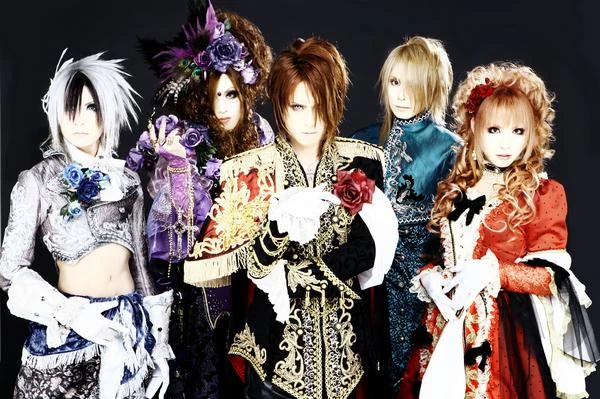
The band above is Versailles, one of the most popular tanbi kei bands. While they are no longer active as a group, the vocalist Kamijo, is still participating in solo activities and still engages in the tanbi kei style. Aside from the classical European-influence in their clothing, their music also mixes classical instruments, such as the violin, with rock and metal styles for a very distinct sound.
The neo-visual style mixes kote kei and oshare kei with milder, more fashionable looks. Their music is more mainstream and framed in a more aggressive, live-oriented band sound. This style peaked in the mid- to late-2000s and some of the most popular and well-liked visual kei bands fall under this category. A great amount of emphasis is put on engaging the audience during live performances. Audience members participate in what is known as furitsuke, which are choreography such as hand movements and head banging that the audience does in unison during the performance. Some bands that fall under the neo-visual style of visual kei are the GazettE, Alice Nine, and nightmare.
The last most popular form of visual kei is known as soft visual. This usually refers to bands that were originally old-school or tanbi kei bands that gradually toned down their looks and sound after gaining popularity. This is not an uncommon trend, since a lot of bands, especially after a couple of years, do not dress as elaborately or wear as much makeup as they initially did when they debuted. Most of the bands that are considered soft visual do not look or really sound visual kei, but are usually linked to the style because of a member’s former band or they type of live houses at which they usually perform. Janne Da Arc and LUNA SEA are examples of soft visual bands.
While visual kei does refer more to appearances than sound, visual kei bands definitely have a kind of sound that is linked to the genre. Perhaps that is the beauty of visual kei. Visual kei is a style where both looks and sounds can be incorporated and manipulated by bands, where no two bands will emulate the same exact style. The great amount of diversity within visual kei is also what ties all of it together.
08 April 2015
Field Notes 03
Live Performance of the GazettE
Watched LIVE TOUR 13-14 [MAGNIFICENT MALFORMED BOX] FINAL CODA LIVE AT 01.11 YOKOHAMA ARENA
This was the live tour that accompanied the release of their seventh album, "Beautiful Deformity", that ran from 2013 until the final on January 11, 2014 at Yokohama Arena, Japan.
Track Listing/Live Set
Part One
- MALFORMED BOX
- INSIDE BEAST
- UNTIL IT BURNS OUT
- FADELESS
- 鴉 (Karasu)
- HEADACHE MAN
- 13STAIRS[-]1
- DEVOURING ONE ANOTHER
- LOSS
- REDO
- LAST HEAVEN
- IN BLOSSOM
- THE STUPID TINY INSECT
- ATTITUDE
- 黒く澄んだ空と残骸と片翅 (Kuroku to Sunda Sora to Zangai to Kataha)
- COCKROACH
- DISCHARGE
- TO DAZZLING DARKNESS
- CODA
Encore
- RIDE with the ROCKERS
- TOMORROW NEVER DIES
- HYENA
- SLUDGY CULT
- Filth in the beauty
- 関東土下座組合 (Kanto Dogeza Kumiai)
- LINDA ~candydive Pinky heaven~
Observations:
- First act consisted of songs mostly from their seventh album on which the tour was based, "Beautiful Deformity"
- First act also featured two songs from their fourth album "DIM" (2009), two songs from their second album "NIL" (2006), and one song from their sixth album "DIVISION" (2012)
- Second act consisted of older songs that I consider "live staples" since most of these songs are played at all their lives, almost religiously
- RIDE with the ROCKERS is a bass/drum track that then progresses to include the two guitars, no vocals. This song has been performed since their Decomposition Beauty Tour (circa 2007), but the arrangement is always different though the name is kept the same
- Second act include two songs from their fifth album "TOXIC" (2011) and two songs from their third album "STACKED RUBBISH" (2007)
- The last two songs were songs that were released on singles only, never a full album
- Traditional finale song of LINDA ~candydive Pinky heaven~
First act consisted of a lot of imagery. Three triangular screens showed song lyrics, pictures, and other imagery. The last song on the first act, CODA, which is also the outro song on the album "Beautiful Deformity", was accompanied by a 3D overlay that showed images consistent with the style of the that album.
Watched LIVE TOUR 13-14 [MAGNIFICENT MALFORMED BOX] FINAL CODA LIVE AT 01.11 YOKOHAMA ARENA
This was the live tour that accompanied the release of their seventh album, "Beautiful Deformity", that ran from 2013 until the final on January 11, 2014 at Yokohama Arena, Japan.
Track Listing/Live Set
Part One
- MALFORMED BOX
- INSIDE BEAST
- UNTIL IT BURNS OUT
- FADELESS
- 鴉 (Karasu)
- HEADACHE MAN
- 13STAIRS[-]1
- DEVOURING ONE ANOTHER
- LOSS
- REDO
- LAST HEAVEN
- IN BLOSSOM
- THE STUPID TINY INSECT
- ATTITUDE
- 黒く澄んだ空と残骸と片翅 (Kuroku to Sunda Sora to Zangai to Kataha)
- COCKROACH
- DISCHARGE
- TO DAZZLING DARKNESS
- CODA
Encore
- RIDE with the ROCKERS
- TOMORROW NEVER DIES
- HYENA
- SLUDGY CULT
- Filth in the beauty
- 関東土下座組合 (Kanto Dogeza Kumiai)
- LINDA ~candydive Pinky heaven~
Observations:
- First act consisted of songs mostly from their seventh album on which the tour was based, "Beautiful Deformity"
- First act also featured two songs from their fourth album "DIM" (2009), two songs from their second album "NIL" (2006), and one song from their sixth album "DIVISION" (2012)
- Second act consisted of older songs that I consider "live staples" since most of these songs are played at all their lives, almost religiously
- RIDE with the ROCKERS is a bass/drum track that then progresses to include the two guitars, no vocals. This song has been performed since their Decomposition Beauty Tour (circa 2007), but the arrangement is always different though the name is kept the same
- Second act include two songs from their fifth album "TOXIC" (2011) and two songs from their third album "STACKED RUBBISH" (2007)
- The last two songs were songs that were released on singles only, never a full album
- Traditional finale song of LINDA ~candydive Pinky heaven~
First act consisted of a lot of imagery. Three triangular screens showed song lyrics, pictures, and other imagery. The last song on the first act, CODA, which is also the outro song on the album "Beautiful Deformity", was accompanied by a 3D overlay that showed images consistent with the style of the that album.
05 April 2015
02 April 2015
Field Notes 02
Music Styles
Listened to songs and watched their accompanying music videos from some of the most notable bands of the different styles.
MALICE MIZER
Song: "Bel Air"
Video/Song Length: 7min 25sec
Video Observation:
- Lot of European scenery, castles
- Christian religious symbols (church, cathedral, crosses)
- Long cinematic opening
- Band is performing in what appears to be an empty church
- Classical European-inspired clothing
- GACKT, the vocalist, resembles a prince
Song Observation:
- Sounds a bit like a circus
- Sounds that resemble a music box play throughout the song and creates a sound of tranquility among the slightly chaotic instrumental
- Was a bit noisy, GACKT's voice seemed to be competing with the instrumental rather than working with it
DIR EN GREY
Song: 鱗 (Uroko)
Video/Song Length: 4min 5 sec
Video Observation:
- Frightful imagery
- People with missing limbs/prosthetic limbs
- Blood, saliva
- Band members performing in crystal/transparent boxes
- Bathtubs, dinner tables
- Very dark, grim, and scary
Song Observation:
- Heavy metal screaming, yelling, and growling
- Opera vocals occur throughout the song
- Very dark and grim, fit the video very well
- Did not like, personally
AN CAFE
Song: "Kakusei Heroism"
Video/Song Length: 4min 26sec
Video Observation:
- Bright lights
- Grunge style clothing
- Fun style video, camera angles, etc.
- Video didn't present any special imagery
- Focus more on the members
Song Observation:
- Very upbeat music and vocals, especially in comparison to the previous video/song
- Pop sound
- Light rock influences
- Sounds like it could be the opening theme of an anime
- Song doesn't really build or evolve much
- A tad boring
Versailles
Song: "Aristocrat's Symphony"
Song/Video Length: 8min 20sec
Video Observation:
- Classical European imagery
- A lot of lit candles
- Takes place in and around a castle
- Dark night, full moon, lightning in the sky
- Long cinematic introduction
Song Observation:
- Opera-influenced opening
- Classical sounds lead into a rock sound
- Mixed classical, opera, and rock elements
- Noisy
- Vocals seemed very overpowered by the instrumental
- Almost headache-inducing
the GazettE
Song: 紅蓮 "Guren"
Song/Video Length: 5min 53sec
Video Observation:
- White paint flowing from a sink that eventually overflows and gets onto the floor
- A young girl in a white dress puts her hands into the white paint and begins to smear it on the red walls
- The members are performing in the same room but it has now been completely covered in white
- Girl's dress becomes covered in the white paint as well
- White is commonly associated with death in most Asian cultures, including Japanese
Song Observation:
- Rock ballad
- Steady instrumental progression
- Music sounds a bit dark
Listened to songs and watched their accompanying music videos from some of the most notable bands of the different styles.
MALICE MIZER
Song: "Bel Air"
Video/Song Length: 7min 25sec
Video Observation:
- Lot of European scenery, castles
- Christian religious symbols (church, cathedral, crosses)
- Long cinematic opening
- Band is performing in what appears to be an empty church
- Classical European-inspired clothing
- GACKT, the vocalist, resembles a prince
Song Observation:
- Sounds a bit like a circus
- Sounds that resemble a music box play throughout the song and creates a sound of tranquility among the slightly chaotic instrumental
- Was a bit noisy, GACKT's voice seemed to be competing with the instrumental rather than working with it
DIR EN GREY
Song: 鱗 (Uroko)
Video/Song Length: 4min 5 sec
Video Observation:
- Frightful imagery
- People with missing limbs/prosthetic limbs
- Blood, saliva
- Band members performing in crystal/transparent boxes
- Bathtubs, dinner tables
- Very dark, grim, and scary
Song Observation:
- Heavy metal screaming, yelling, and growling
- Opera vocals occur throughout the song
- Very dark and grim, fit the video very well
- Did not like, personally
AN CAFE
Song: "Kakusei Heroism"
Video/Song Length: 4min 26sec
Video Observation:
- Bright lights
- Grunge style clothing
- Fun style video, camera angles, etc.
- Video didn't present any special imagery
- Focus more on the members
Song Observation:
- Very upbeat music and vocals, especially in comparison to the previous video/song
- Pop sound
- Light rock influences
- Sounds like it could be the opening theme of an anime
- Song doesn't really build or evolve much
- A tad boring
Versailles
Song: "Aristocrat's Symphony"
Song/Video Length: 8min 20sec
Video Observation:
- Classical European imagery
- A lot of lit candles
- Takes place in and around a castle
- Dark night, full moon, lightning in the sky
- Long cinematic introduction
Song Observation:
- Opera-influenced opening
- Classical sounds lead into a rock sound
- Mixed classical, opera, and rock elements
- Noisy
- Vocals seemed very overpowered by the instrumental
- Almost headache-inducing
the GazettE
Song: 紅蓮 "Guren"
Song/Video Length: 5min 53sec
Video Observation:
- White paint flowing from a sink that eventually overflows and gets onto the floor
- A young girl in a white dress puts her hands into the white paint and begins to smear it on the red walls
- The members are performing in the same room but it has now been completely covered in white
- Girl's dress becomes covered in the white paint as well
- White is commonly associated with death in most Asian cultures, including Japanese
Song Observation:
- Rock ballad
- Steady instrumental progression
- Music sounds a bit dark
Subscribe to:
Comments (Atom)